

Following business and economy news from Brunei
Provided by AGP
WEEX Publishes XRP Analysis Covering Regulatory Clarity, Market Demand, and Future Growth Drivers
WEEX examines XRP’s shift from lawsuit-driven sentiment toward a new phase shaped by payments utility, stablecoin adoption, ETF access, and trading liquidity.
SINGAPORE, May 21, 2026 (GLOBE NEWSWIRE) -- WEEX has published a new market analysis on XRP, outlining how the asset’s narrative is evolving after years of regulatory uncertainty. The report focuses on XRP’s transition from a token heavily influenced by the Ripple lawsuit to one increasingly assessed through market demand, liquidity conditions, payment relevance, and institutional access.
The analysis follows a major change in XRP’s legal backdrop. In 2025, the U.S. Securities and Exchange Commission announced a joint stipulation to dismiss appeals in its civil enforcement action involving Ripple, helping reduce one of the most persistent uncertainties around the asset. WEEX notes that this development changed the market conversation, but did not remove the need for XRP to demonstrate durable demand beyond legal relief.
According to WEEX, XRP’s next phase will be measured less by courtroom milestones and more by how the asset performs in a market where stablecoins, exchange-traded products, and institutional liquidity are reshaping crypto access. The report argues that XRP now faces a more practical test: whether its payment-focused design can continue to matter as tokenized dollars and regulated investment products expand.
XRP was created as the native asset of the XRP Ledger, a network launched in 2012 to support fast and low-cost value transfer. Unlike proof-of-work networks, XRPL does not rely on mining. It uses a validator-based consensus process, with XRP functioning as the native asset required for transaction costs. Standard XRP Ledger transactions typically settle within seconds, while the minimum transaction cost remains 0.00001 XRP.
WEEX’s analysis says these technical characteristics remain central to the XRP thesis. XRP was not designed around the same scarcity narrative as bitcoin or the broad smart contract ecosystem associated with Ethereum. Instead, its long-term story has been tied to payments, liquidity, treasury movement, and settlement. That positioning continues to support XRP’s relevance, but it also exposes the asset to sharper questions as stablecoins become one of crypto’s clearest use cases.
Stablecoins have become widely used for trading, transfers, settlement, and dollar-denominated movement across digital asset platforms. Ripple’s RLUSD stablecoin, launched globally in December 2024 on both the XRP Ledger and Ethereum, gives the XRP ecosystem a more current role in this discussion. WEEX notes that meaningful RLUSD activity on XRPL could strengthen the ledger’s position in payment infrastructure, while also raising a key question: if users prefer dollar-backed tokens for settlement, what demand does XRP itself capture?
The report frames this as the central issue for XRP’s next stage. Legal clarity can make XRP easier for exchanges, product issuers, and market makers to support. It can also improve confidence among traders who previously avoided the asset because of regulatory uncertainty. However, WEEX emphasizes that legal clarity alone does not create organic token demand. XRP still needs to show that liquidity, network activity, and payment relevance can support long-term value beyond the former lawsuit narrative.
Exchange-traded products are another important part of the new market structure. By late 2025, U.S.-listed XRP products from issuers including Canary, Bitwise, Franklin Templeton, and Grayscale had expanded access to XRP through traditional financial channels. These products can make XRP easier to own for investors who prefer brokerage accounts over wallets, private keys, or direct crypto exchange custody.
At the same time, broader access may increase scrutiny. WEEX’s analysis notes that once an asset becomes easier to buy, investors are more likely to ask why it should be bought. For XRP, that answer cannot rest only on ETF availability. It must also involve liquidity depth, payment relevance, and a credible role within the stablecoin and tokenized finance stack.
For active traders, XRP remains one of the more recognized and liquid digital assets. It can respond quickly to regulatory updates, ETF flow expectations, Ripple-related announcements, stablecoin developments, and broader altcoin market momentum. WEEX says this makes execution and risk management especially important.
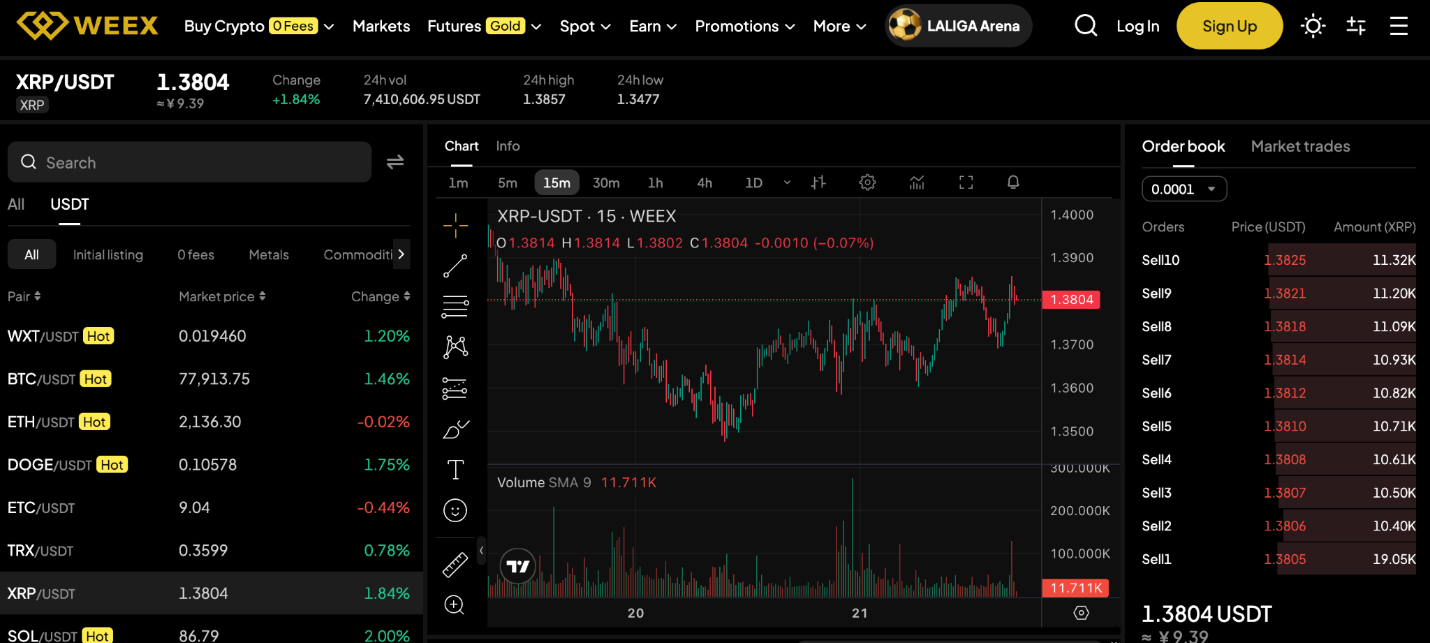
Users seeking direct exposure can follow the XRP/USDT spot market on WEEX. Spot trading may be suitable for users who want to buy, hold, or sell XRP without leverage. More experienced traders can also access XRP/USDT perpetual futures on WEEX, where margin, position sizing, and liquidation risk require stricter discipline.
WEEX also highlights the importance of education before trading. New users who want to understand the asset and basic purchase process can read WEEX’s guide on how to buy XRP before entering the market.
The report concludes that XRP’s second act will not be defined only by the resolution of past legal pressure. Instead, XRP must prove its relevance in a crypto market where stablecoins handle much of the payment flow, ETFs improve asset access, and liquidity determines which assets remain institutionally relevant.
Media Contact:
Ruth Ai
ruth@weexglobal.com
Disclaimer: This sponsored content is provided by the content provider and does not necessarily reflect the views of this media platform or its publisher. The information is shared for general informational purposes only and should not be considered financial, investment, or trading advice. Cryptocurrency and mining-related activities carry risks, including the potential loss of capital, and readers are encouraged to conduct their own research and seek professional advice where appropriate. Speculate only with funds that you can afford to lose.The media platform and publisher assume no responsibility for any losses or claims arising from reliance on this content. GlobeNewswire does not endorse any content on this page.
Legal Disclaimer: This article is provided on an “as-is” basis, without warranties or representations of any kind, express or implied. The media platform assumes no responsibility or liability for the accuracy, content, completeness, legality, or reliability of the information presented. Any complaints, claims, or copyright concerns related to this article should be directed to the content provider mentioned above.
Photos accompanying this announcement are available at
https://www.globenewswire.com/NewsRoom/AttachmentNg/810a832b-7f14-4886-99d5-33543953567e
https://www.globenewswire.com/NewsRoom/AttachmentNg/701192c4-8bf9-4fac-897b-f94b98ecc440


WEEX
WEEX
WEEX
WEEX
Legal Disclaimer:
EIN Presswire provides this news content "as is" without warranty of any kind. We do not accept any responsibility or liability for the accuracy, content, images, videos, licenses, completeness, legality, or reliability of the information contained in this article. If you have any complaints or copyright issues related to this article, kindly contact the author above.
